From engine blocks to street lanterns and cookware, cast iron is used in a wide range of applications thanks to its excellent castability and cost-effectiveness. Its properties depend largely on the type and shape of carbon it contains, making metallographic analysis essential for understanding and ensuring the quality of cast iron components.
Here you will find essential information on the metallographic preparation of cast iron, including its different types, classification, and recommended preparation methods.
Topics
Cast iron is an iron-based alloy family containing more than 2.06% carbon, typically around 3% carbon and 2% silicon, along with elements such as manganese, phosphorus, and sulphur. Shaped primarily through casting, cast iron can be classified by the shape of the graphite it contains. Gray cast iron (CJL) features lamellar graphite, providing excellent castability, vibration damping, high thermal conductivity, and good machinability. Ductile iron (CJS) contains nodular graphite formed by adding magnesium or cerium; this results in high ductility and mechanical properties similar to steel. Compacted graphite iron (CGI; CJV) contains worm-like graphite shapes, produced by adding smaller amounts of magnesium or cerium, and offers a balance of strength and thermal conductivity. White cast iron is the only type that does not contain free graphite.
Cast iron stands out as one of the most cost-effective construction materials, offering excellent castability and minimal shrinkage during solidification. However, it is brittle, has limited strength at high temperatures, and cannot be plastically deformed. Thanks to its properties, cast iron is widely used for large components such as engine blocks, machine housings, crankshafts, building parts, as well as cookware and radiators.
The metallographic preparation of cast iron is a vital step in quality control, as the mechanical properties of the material are strongly affected by the morphology (e.g., shape, volume) of the graphite. The characterization of graphite in cast iron can be performed directly on the polished, unetched sample, usually using standard reference charts or image analysis methods. However, etching is required to reveal and assess the structure of the iron matrix itself. Precise metallographic analysis is essential not only for process control during production, but also for the ongoing development and optimization of cast iron materials.
Due to its brittle nature and relatively high hardness, cast iron requires careful sectioning to avoid introducing microstructural damage such as cracks, overheating, or graphite pull-out. The cutting strategy depends on the type of cast iron:
To ensure clean and damage-free cuts, it is important to use a precision cut-off machine with adequate coolant flow to prevent overheating. Apply moderate feed pressure to avoid microcracks or chipping, and make sure the sample is firmly clamped to prevent movement or vibration during cutting.
Mounting is recommended for cast iron samples that require high edge quality and consistent preparation, such as in failure analysis or detailed microstructural evaluation. However, for large specimens or routine quality control, unmounted preparation is commonly used to save time and resources.
When mounting is necessary, hot mounting is the preferred method due to its speed and durability. We recommend using EPO BLACK a high-performance, mineral- and glass-filled epoxy resin. It offers very low gap formation, excellent edge retention, and high parallelism. The high filler content also improves machinability, especially important for harder types of cast iron. For standard applications Bakelite is a cost-effective alternative.
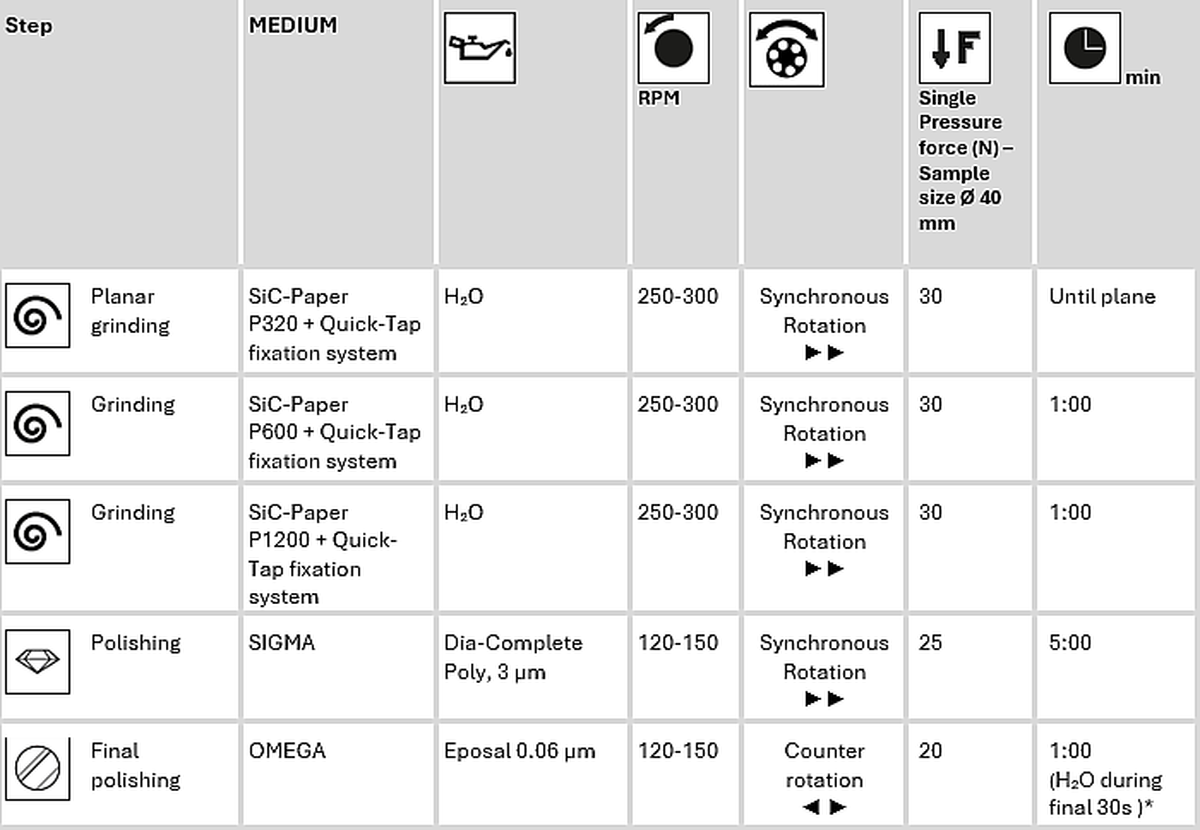
Proper grinding and polishing are essential for revealing the microstructure of cast iron without introducing deformation or damaging the graphite structure. The goal is to produce a flat, scratch-free surface that preserves both the graphite morphology and the matrix, enabling accurate metallographic evaluation. A recommended preparation method for CJS and CJL type cast iron is shown in the table.
Cast iron is prone to corrosion during and after preparation, so cleaning must be done quickly and carefully. Always use cold water for the initial rinse but avoid leaving the sample exposed to water for extended periods. Follow immediately with a thorough rinse in ethanol and dry the specimen using warm air.
When evaluating the graphite morphology in cast iron, i.e. the shape, size, and distribution of graphite, etching is not necessary, as graphite is already visible on the polished, unetched surface. However, to study the metallic matrix and phases within the microstructure in more detail, chemical etching is required. An overview of the most common etchants for cast iron is given in the table below:
Safety Notice: Acids must be used with caution. Wear protective equipment and follow lab safety guidelines.
| Composition | Etching Conditions | Description |
| 100 ml ethanol, min. 96% 1-10 ml nitric acid, 65% (Nital) |
5 – 60 seconds depending on material | Etches ferrite, pearlite, and martensite. Graphite remains unchanged. |
| 100 ml Ethanol (96 %)> 2-4 g Picric acid |
10 – 120 seconds depending on material | Etches pearlite, martensite and bainite. Uniform etching, even with segregations. Fe3C stained light yellow. |
Metallographic preparation is essential for evaluating the internal structure of cast iron. It allows you to assess features like graphite distribution and matrix phases, which directly influence mechanical properties such as strength, ductility, and wear resistance.
Common types include gray cast iron (CJL), ductile cast iron (CJS), compacted graphite iron (CGI), and white cast iron. They differ primarily in the form and distribution of carbon, which affects their performance, machinability, and application areas.
Yes, especially for large components or routine quality checks. However, for detailed analysis and edge-sensitive applications, mounting the sample — typically using hot compression mounting — provides better control and repeatability.
Cast iron is brittle and often hard, which makes it prone to cracking, chipping, or graphite pull-out during cutting and grinding. Selecting the right tools and process parameters is crucial to avoid introducing preparation artifacts.
To minimize corrosion, clean cast iron samples quickly using cold water, rinse thoroughly with ethanol, and dry with warm air. Avoid prolonged exposure to moisture and use water-free alcohol for especially corrosion-sensitive specimens.
It depends on what you want to examine. Graphite features — such as shape and distribution — are visible on a polished, unetched surface. But to analyze the metallic matrix (e.g., pearlite, ferrite, or carbides), etching is required, typically using Nital or Murakami’s reagent.
Si tiene alguna pregunta adicional, no dude en ponerse en contacto con nosotros a través de nuestro formulario de contacto. Estaremos encantados de ayudarle a encontrar la mejor solución para sus necesidades de preparación de muestras metalográficas.
QATM offers a wide range of innovative and robust instruments for materialography, metallography and hardness testing. Our experts know the requirements of each branch of industry and and will be happy to assist in finding the right solution for your application.