Titanium and Ti-alloys are valued for high strength-to-weight ratios, corrosion resistance, and biocompatibility, making them essential in fields like aerospace, medicine, and chemical processing. To verify that manufacturing and heat treatment have produced the desired microstructure, the metallographic preparation and analysis of titanium and its alloys are essential. This guide outlines the complete preparation process from cutting and mounting to grinding, polishing, and etching and adds practical tips for achieving reproducible, artifact-free results.
Topics
Titanium is a lightweight metal with a high strength-to-weight ratio, exceptional corrosion resistance, and excellent biocompatibility, making it ideal for demanding applications in aerospace, chemical processing, marine engineering, and medical implants. Its low density (~4.5 g/cm³) and non-toxic nature further contribute to its widespread use.
While titanium is more costly than steel or aluminium, its performance advantages often justify the investment, especially where reliability and durability are critical. Commercially pure titanium is relatively soft (HV ~200) and highly ductile, whereas many titanium alloys can reach strengths above 1000 MPa through alloying and heat treatment. Due to the high reactivity of molten titanium, components are rarely cast in the liquid phase. Instead, titanium is typically processed through solid-state methods such as forging, rolling, or additive manufacturing. While corrosion resistant, its use at elevated temperatures is generally limited due to reactivity with oxygen and nitrogen.
Titanium exists in two crystal forms: a hexagonal α-phase at low temperatures and a body-centred cubic β-phase at high temperatures. This transformation is key to classifying titanium alloys. The main groups include:
Because the ratio and distribution of α and β phases directly affect the mechanical performance of titanium alloys, metallographic analysis is essential to confirm that processing and heat treatment have produced the intended microstructure.
Metallographically preparing titanium is notoriously challenging and requires a tailored approach for each step. Titanium’s high ductility means it is prone to plastic deformation and smearing during grinding or polishing if one is not careful.
Titanium is a relatively tough and ductile metal, which makes it susceptible to smearing, burr formation, and thermal damage during sectioning. Standard abrasive cut-off wheels, especially those based on aluminium oxide, tend to perform poorly on titanium, often generating excessive heat (noticeable by its characteristic burning smell) and leaving a rough surface or pronounced burr.
For clean, damage-free cuts, it is essential to use a cut-off wheel specifically designed for titanium, such as a silicon carbide (SiC)-based wheel with a resin bond. We recommend our Ti-A wheel, which is engineered for titanium alloys like Ti-6Al-4V and Ti-5Al-2.5Sn, as well as other refractory metals such as molybdenum, tantalum, and niobium. Always use adequate coolant flow to keep the sample and cutting area cool and to flush away reactive titanium swarf. This not only protects the microstructure but also helps reduce the risk of dust ignition and tool wear.
To minimize heat generation and surface deformation, a slow feed rate is crucial. A cutting speed in the range of 0.1–0.25 mm/s is typically recommended. For harder titanium alloys or critical specimens, the feed rate can be further reduced to prevent heat buildup and ensure structural integrity at the cutting edge.
Proper specimen fixation is also key: the sample must be securely clamped on both sides of the cut line to prevent vibration, deflection, or sudden break-off during the final phase of the cut. Thin sheets or plates should be backed with a supporting material, such as a fibre-reinforced plate or HPL board, to avoid bending or collapsing during sectioning.
In production environments, large titanium components are often prepared without mounting due to their size and handling stability. However, for small, precision-manufactured parts, mounting is essential to ensure accurate, repeatable results and protect sample edges during preparation.
Both hot and cold mounting methods are suitable for titanium. For hot mounting, we recommend EPO BLACK, a mineral- and glass-filled epoxy resin-based material that provides excellent edge retention, minimal gap formation, and high plane parallelism, ideal for critical metallographic analysis. Alternatively, EPO MAX, with similar properties but shorter cycle times.
When heat exposure must be avoided, cold mounting is preferred. Options include KEM 20, a transparent, methylmethacrylate-based resin suited for target preparation, or KEM 15+, which offers very low shrinkage and high edge retention, making it ideal for fine structures and edge-sensitive samples.
Titanium's ductility and low thermal conductivity make it particularly sensitive to mechanical deformation, smearing, and surface damage during grinding and polishing. If not properly controlled, preparation can easily introduce a deformed surface layer that obscures the true microstructure and is difficult to remove. The objective is to create a flat, scratch-free, and deformation-free surface that accurately reveals the grain structure, phase distribution, and other key features. This requires a careful balance of mechanical and chemical action, along with appropriate consumables and preparation parameters tailored to titanium. Achieving this requires well-matched consumables, precise process control, and in many cases, a chemically assisted final polish.
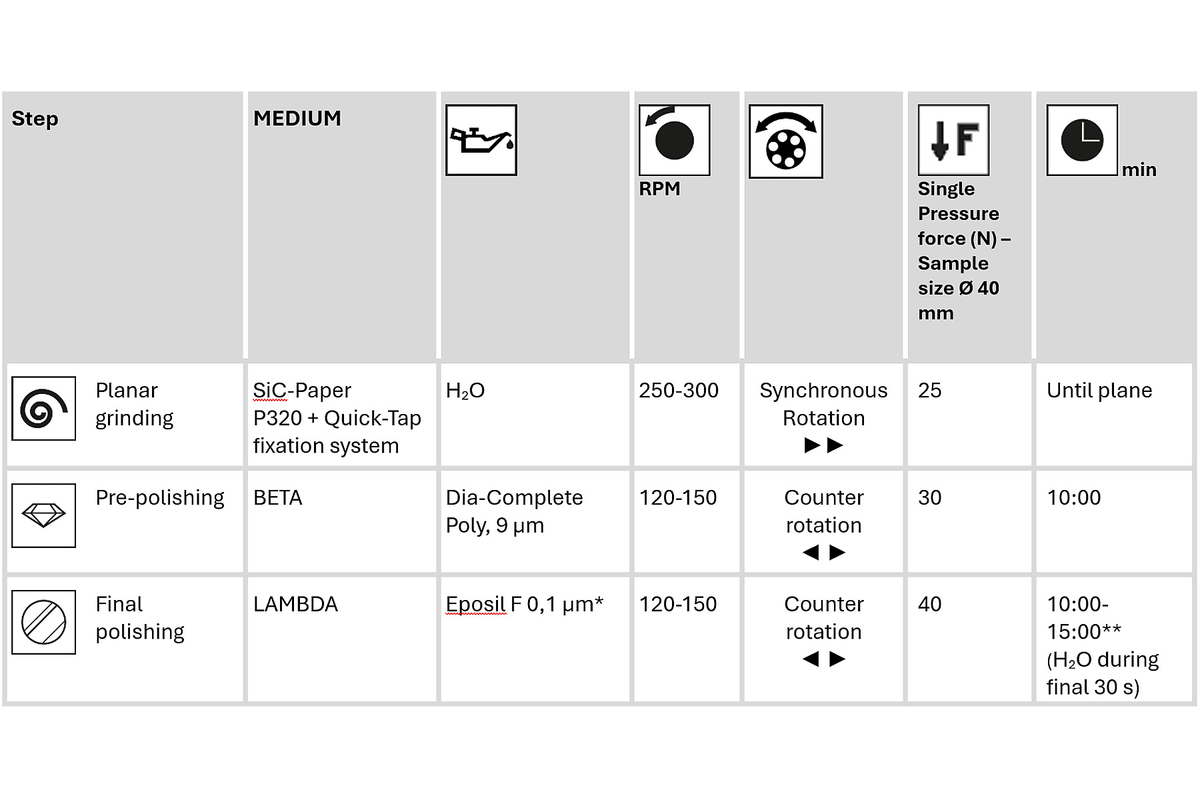
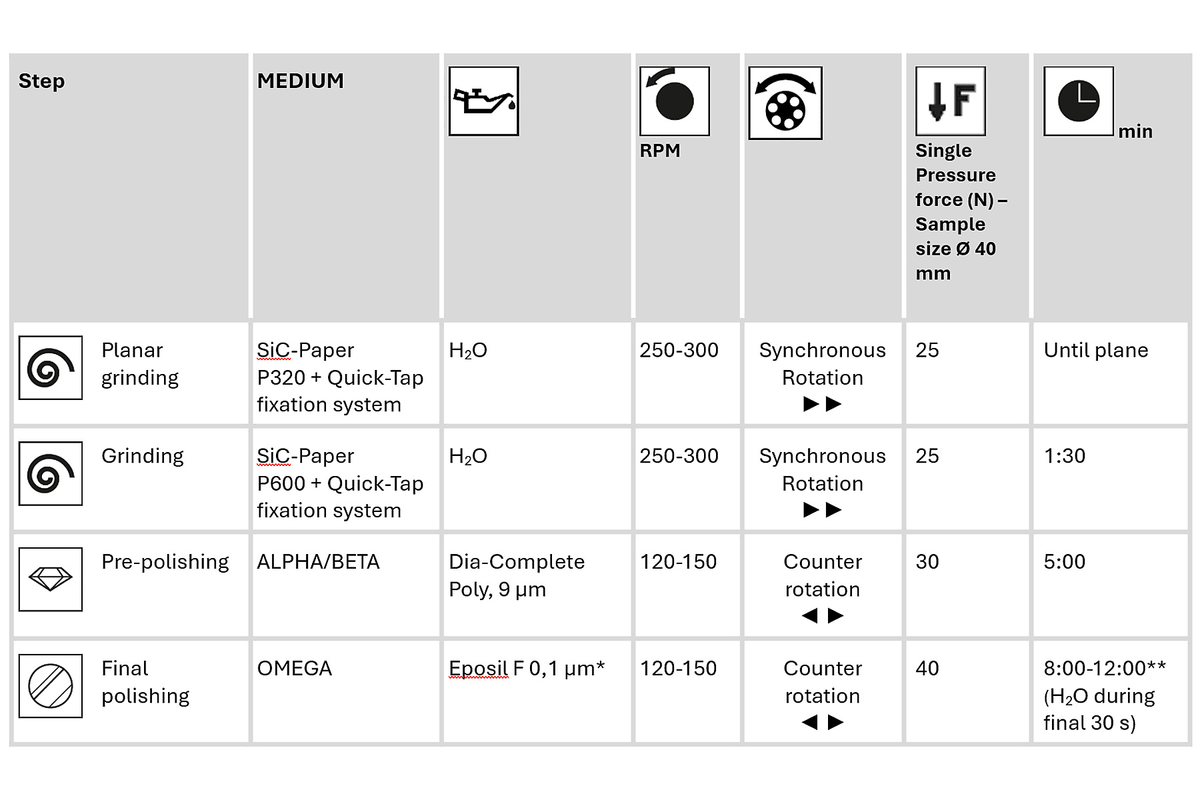
To minimize deformation and smearing during preparation, planar grinding of titanium should begin with a moderately fine SiC paper or foil, avoiding overly coarse abrasives. This helps limit surface damage and ensures easier removal of deformation in later steps. Polishing is typically done in two stages: first with an abrasive diamond suspension (typically 9 µm), such as DiaComplete Poly, a water-based suspension for efficient material removal; and second with a chemical-mechanical final polish using Eposil F (0.1 µm), mixed with 35% hydrogen peroxide in a 5:1 ratio. (Safety note: Always wear appropriate personal protective equipment when handling peroxide.) This final step is crucial for eliminating the disturbed surface layer and revealing a clean, undistorted microstructure.
The following tables present recommended preparation methods:
* * Eposil F must be mixed with hydrogen peroxide (35%) in a ratio of 5:1 (safety advice: use personal protective equipment)
** ** Depends on the alloy
Si tiene alguna pregunta adicional, no dude en ponerse en contacto con nosotros a través de nuestro formulario de contacto. Estaremos encantados de ayudarle a encontrar la mejor solución para sus necesidades de preparación de muestras metalográficas.
After final polishing, titanium samples often appear mirror-like and may reveal faint structural contrast under polarized light. However, to clearly observe features such as grain boundaries, phase differences, and deformation structures, chemical etching is typically required.
Several etchants are commonly used for titanium and its alloys, each with specific strengths:
The table below summarizes these three common etchants and their typical applications:
Safety Notice: Acids must be used with caution. Wear protective equipment and follow lab safety guidelines.
Always handle hydrofluoric acid with extreme caution, as even small exposures can be life-threatening!
| Composición | Condiciones de grabado | Descripción |
| 100 ml distilled water 2 to 6 ml nitric acid 65% 1 to 3 ml hydrofluoric acid 40% (Kroll) |
Apply 5 – 30 s depending on material | Visualization of the microstructure of titanium alloys, especially TiAlV alloys. Pre-mixed Kroll’s etchant can be conveniently ordered from our consumables web shop. |
95 ml distilled water 1.5 ml hydrochloric acid 32% 2.5 ml nitric acid 65% 0.5 ml hydrofluoric acid 40% (Keller) |
Apply 10 to 30 seconds, then rinse with lukewarm water | For etching titanium alloys | 100 ml distilled water 50 ml ethanol min. 96% 2 g Ammonium hydrogen difluoride (Weck) |
Apply 5 to 60 seconds Good etching is achieved when the colour of the cuticle changes from brown to blue. The samples must be immersed in dry state into the etchant |
Etching of titanium and Ti alloys; alpha/beta solid solutions are coloured. Hydride and nitride needles, oxygen-rich diffusion zones and beta phase remain white. |
The hardness testing of titanium and its alloys is influenced by several factors, including chemical composition, heat treatment, and resulting microstructure. All standard hardness testing methods (Vickers, Rockwell, Brinell) are applicable. Pure titanium is relatively soft, typically measuring around 20 HRC or HV 220. In contrast, titanium alloys can achieve significantly higher hardness values, reaching up to 40 HRC or HV 380, depending on their formulation and processing.
Titanium is highly ductile and has low thermal conductivity, which makes it prone to smearing, surface deformation, and heat buildup during grinding and cutting. It also rapidly forms a hard oxide layer, which can cause fine scratching or interfere with etching if not fully removed.
Yes, large or flat samples may be prepared without mounting, especially in production environments. However, mounting is recommended for small components or when edge preservation is critical, as it improves handling, consistency, and edge retention during polishing. Both hot and cold mounting is possible for titanium. A mounting medium with high edge retention is recommended such as EPO-BLACK/MAX (Hot mounting) or KEM 15 plus/ 20 (Cold Mounting).
Colloidal silica combined with hydrogen peroxide removes the mechanically disturbed surface layer left by prior steps. This final polish is crucial for revealing a clear, undistorted microstructure, especially in commercially pure titanium, where mechanical polishing alone often leaves residual deformation.
A polished titanium surface should appear mirror-like and show minimal surface texture under polarized light. If microstructural features remain faint or show signs of distortion after etching, the surface likely still contains deformation and requires further chemical-mechanical polishing.
Excessive burring, overheating, and sample vibration are common challenges when cutting titanium due to its toughness and low thermal conductivity. These issues can lead to poor surface quality and microstructural damage. To minimize them, we recommend using silicon carbide cut-off wheels, e.g., our Ti-A wheel, along with slow feed rates (<2,5 mm/s), secure clamping, and adequate coolant flow. This helps prevent thermal damage and ensures a clean, undistorted cut.
While the general preparation process is similar, alloy composition affects behaviour. For example, commercially pure titanium is more prone to smearing and needs gentler polishing, while β alloys may be harder and polish more easily. Etching responses also vary, so etchant choice and timing may need adjustment based on the alloy.
These “pollution marks” are often caused by contamination or residues left on the polishing cloth or sample. To fix this, clean the sample with a soft tissue (e.g., cosmetic tissue), rinse the polishing cloth thoroughly with a soft brush under running water, and clean the sample holder as well. Then repeat the final polishing step briefly to restore a clean, uniform surface.
Si tiene alguna pregunta adicional, no dude en ponerse en contacto con nosotros a través de nuestro formulario de contacto. Estaremos encantados de ayudarle a encontrar la mejor solución para sus necesidades de preparación de muestras metalográficas.
QATM offers a wide range of innovative and robust instruments for materialography, metallography and hardness testing. Our experts know the requirements of each branch of industry and and will be happy to assist in finding the right solution for your application.