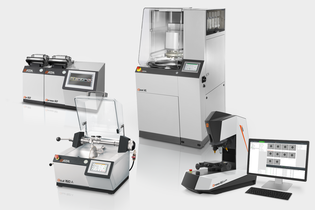





Thin sectioning and mineralogy Sample preparation for rocks, ores, minerals and fossils
Reliable mineralogical analysis starts with sample preparation, not with the microscope. Rocks, ores, minerals, powders and fossils can vary widely in hardness, porosity, structure and sensitivity, making controlled preparation essential for obtaining representative and reproducible results.
From cutting and mounting to vacuum impregnation, grinding, polishing and thin section preparation, each step influences the quality of the final specimen. Incorrect preparation can cause cracks, deformation, material loss, pull-outs and relief formation — and ultimately lead to an analysis that reflects preparation artifacts rather than the material itself.
The following chapters cover the complete preparation chain for geological and mineralogical samples and explain how suitable QATM equipment and QPREP consumables can be selected for different materials, preparation steps and analytical requirements.
鉱物学的試料調製 基礎と応用
鉱物学的試料調製は、岩石、鉱石、鉱物、粉末、化石の構造を保持し、再現性のある顕微鏡的および分析的検査のために準備することにより、信頼性の高い分析の基盤を築きます。
What is thin section preparation in mineralogy?
Thin section preparation is the process of cutting, mounting, bonding to a glass slide, pre-thinning and grinding a rock or mineral sample down to a defined thickness — in most mineralogical workflows approximately 20 to 30 µm — so that the sample becomes transparent and can be examined in transmitted and polarized light.
A thin section is not the same as a polished section. A thin section is examined in transmitted light through both the sample and the glass slide, so thickness and plane parallelism determine whether the optical properties of each mineral phase can be interpreted correctly. A polished section, also called a bulk sample or polished mount, is examined in reflected light, and only the surface has to be flat, scratch-free and free of relief. Thin section preparation adds three steps that polished section preparation does not require: bonding to a glass slide, pre-thinning by cutting, and calibrated final grinding.
Why does sample preparation matter for geological and mineralogical analysis?
Because mineralogical samples are almost never uniform, and every preparation error is recorded permanently in the surface that is later analyzed.
A single rock can contain phases with different hardness, density, porosity and fracture behavior. In mining applications, an ore can contain hard and soft phases in the same specimen, which causes relief formation when grinding and polishing parameters are not controlled. Fossils, powders and soft rocks usually need stabilization before any mechanical preparation is possible.
A controlled preparation process helps a geological or mineralogical laboratory to:
- preserve the original structure and the phase boundaries of the material
- prevent cracks, fractures, pull-outs and edge damage
- reduce material loss during sectioning of limited or valuable samples
- keep pores and cracks filled during mounting, so that they are not enlarged during grinding
- achieve flat, smooth surfaces for light microscopy and scanning electron microscopy
- produce thin sections with a controlled, plane-parallel thickness
- reproduce the same result across operators, shifts and sample batches
Which mineral samples can be prepared with QATM equipment?
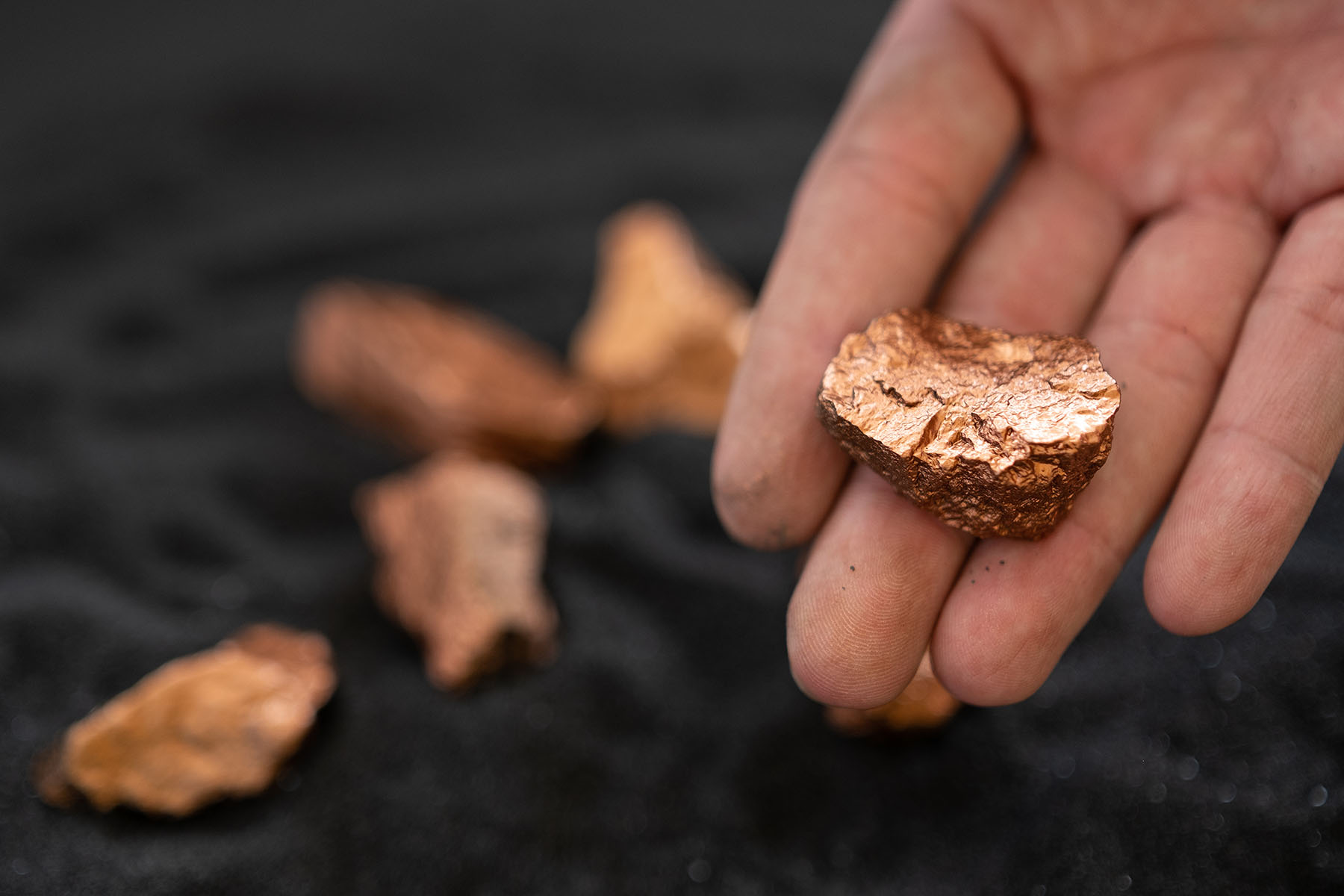
QATM equipment and QPREP consumables are used for rocks, ores, minerals, powders and fossils — hard and brittle materials as well as porous, soft or fractured materials.
| Sample group | Typical materials | Preparation challenge |
|---|---|---|
| Rock samples | Granite, basalt, sandstone, limestone, marble, slate, quartzite, gneiss | High hardness combined with porosity or fissuring; requires uniform support and a good edge connection |
| Ore samples | Iron ore, copper ore, zinc ore, gold-, silver- and platinum-bearing materials | High density and heterogeneity; hard and soft phases in one sample cause relief formation |
| Mineral samples | Quartz, feldspar, calcite, pyrite, tourmaline, beryl, topaz | Transparency, inherent color and structure must remain assessable; discoloration by the mounting material must be avoided |
| Fossil samples | Fossilized plants and animals, bones, shells | Brittle and often porous; requires impregnation before sectioning |
| Powders and soft rocks | Drill cuttings, mineral tailings, crushed and milled products | Must be deagglomerated and fully enclosed by the mounting material to prevent pull-outs |
How is a representative mineral sample cut without damaging it?
Cutting separates a representative sample from the starting material, and the cutting process must be selected according to the hardness, density, porosity and sensitivity of the material. An incorrectly selected or incorrectly performed cut causes damage that cannot be reversed in any later preparation step.
QATM supplies manual, semi-automatic and fully automatic cut-off machines for different materials, geometries and sample sizes. The aim of the cut is a sample with a flat surface and without thermal damage, cracks, deformation or uncontrolled fracture, because that flat surface simplifies every subsequent step.
Brittle, porous or already broken samples should be impregnated with a suitable mounting material before sectioning, so that the material is supported while the cut-off wheel passes through it. Powders and soft rocks must be sufficiently deagglomerated and securely enclosed by the mounting material; otherwise individual particles break out during later grinding and polishing.
Which laboratories and industries use materialographic preparation of mineral samples?
The workflow described on this page is used wherever a mineral phase has to be identified, quantified or documented under a microscope.
- Geology laboratories
- Mining and material extraction, from exploration to process control
- Mineralogy and petrography
- Ore analysis and ore microscopy
- Rock and fossil preparation, including museum and collection work
- Powder and soft rock preparation
- Research institutes and universities
- Quality control laboratories for raw materials, aggregates and building materials
鉱物学的試料調製 鉱物試料の切断、埋込、含浸
制御された切断、埋込、および真空含浸は、鉱物サンプルを安定化させ、孔や亀裂を保護し、損傷のない再現性のあるさらなる調製のための条件を作り出します。
Which cut-off wheel is suitable for rocks, ores and minerals?
For hard and brittle mineral samples, QPREP diamond precision cut-off wheels are the recommended choice, because diamond as an abrasive cuts the hardest materials and separates them without smearing.
QPREP diamond precision cut-off wheels use a bronze bond. The diamonds can be dressed after longer use, so that the wheel returns to full cutting performance instead of being replaced. Other abrasives are available where the sample allows it.
| Cut-off wheel | Recommended for |
|---|---|
| QPREP diamond precision cut-off wheels | Hard and brittle mineral samples, rocks, ceramics and specimens with brittle plasma coatings; resin-bonded versions for hard and brittle materials |
| CBN cut-off wheels | Hardened ferrous materials handled alongside mineral samples in the same laboratory |
| Corundum (aluminum oxide) cut-off wheels | Softer ferrous samples and general-purpose sectioning |
| Silicon carbide cut-off wheels | Non-ferrous and mineral materials of lower hardness |
Cooling and lubrication matter as much as the wheel itself. An effective coolant supply cools and lubricates the sample during the cut, which reduces thermal damage and dust formation — relevant both for sample integrity and for laboratory hygiene when cutting silicate-bearing rock.
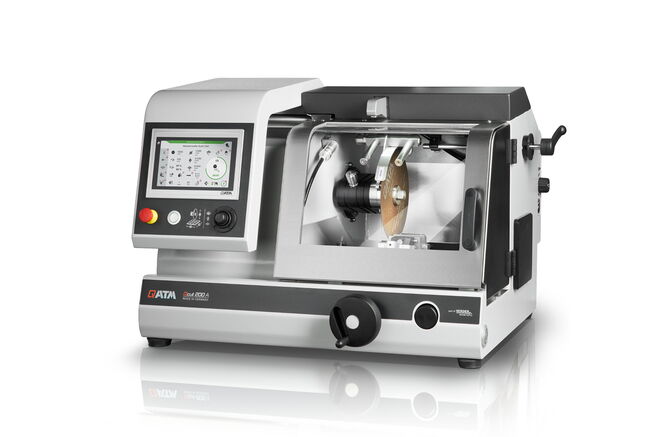
精密切断機 Qcut 200 A
The Qcut 200 A is used in mineralogical laboratories for both cutting and thin section grinding. Functions relevant to geology and mineralogy:
- several operating modes, including a grinding mode with diamond cup wheels
- cross feed for larger and irregular samples
- zone cutting function
- integrated honing device for diamond cutting discs
- integrated database of cutting processes
- high-precision automatic Z-axis for reproducible removal during thin section grinding
How are brittle and porous mineral samples mounted?
Mounting encloses the sample, protects it and provides the mechanical support needed for grinding and polishing. The most common method for mineralogical samples and thin sections is cold mounting with low-viscosity epoxy resin, because the resin penetrates pores and cracks.
For mineralogical samples, the mounting material has a second function beyond mechanical support: its refractive index should be similar to that of glass, so that the later examination in transmitted light is not distorted. The curing time of the epoxy resins used for this purpose is approximately 3 to 24 hours, depending on the selected material.
Mounting requirements differ by sample group. Rock samples with high hardness, porosity or fissuring require uniform support and a good edge connection. Ore samples with high density, heterogeneity or sensitivity require good filling and low shrinkage. Mineral samples with high transparency, inherent color or fine structure require a clear view and low discoloration.
Hot, cold or UV mounting — which method fits which mineral sample?
| Method | Process | Strengths | Limitations for mineral samples |
|---|---|---|---|
| Hot mounting | Carried out in a hot mounting press at high pressure and temperature; thermosetting materials for maximum hardness, thermoplastic materials for transparent mounts | Best edge retention and planarity; suitable for wet chemical etching; also used for powdered samples at typical diameters of 25 to 30 mm | Requires a sample that tolerates heat and pressure; does not impregnate pores and cracks |
| Cold mounting | Chemical curing reaction; acrylic, epoxy and polyester resins available; selection based on reaction time, removal rate and hardness | Suitable for heat- and pressure-sensitive samples; low-viscosity epoxy resins fill pores and cracks and enclose powder particles; grades with a refractive index close to glass are available | Curing time of approximately 3 to 24 hours; vacuum impregnation is needed for full penetration of fine pores |
| UV mounting | Filler-free modified acrylic resins cured by UV irradiation within a narrow wavelength range, in specially designed equipment | Fastest method; no external heat and no high pressure; single-component systems need no mixing, give transparent mounts and support safe laboratory work | Higher viscosity means complete impregnation of fine cracks and pores is usually not achieved |
QPREP mounting materials are available for all three methods. For thin sections, including thin sections of powdered samples, low-viscosity epoxy resins are used, because they fill pores and cracks well and, in the case of powders, enclose the particles reliably.
How does vacuum impregnation fill pores and cracks in mineral samples?
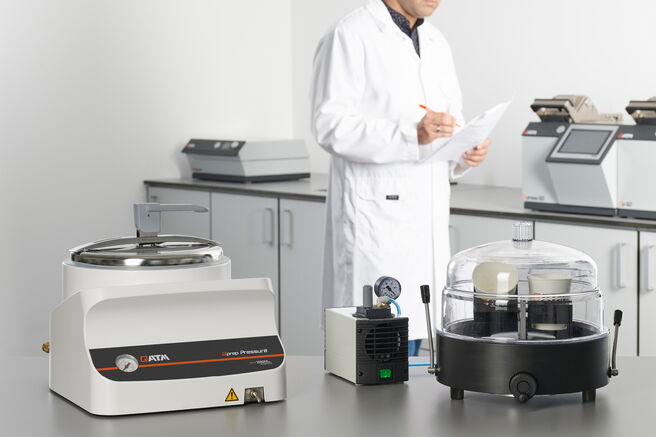
Vacuum impregnation removes the air from pores and cracks before the mounting material is introduced, so that the low-viscosity resin can penetrate cavities that would otherwise stay air-filled and open up during grinding.
The samples to be mounted are placed in the vacuum container of the QATM vacuum impregnation device. The container is evacuated with the connected vacuum pump, which empties the pores and cracks of air. The low-viscosity mounting material then penetrates the cavities under vacuum. After the molds have been filled with mounting material, the vacuum container is vented and the samples are removed for curing.
Two practical measures improve the result:
- For polished specimens it has proven useful to mount an initial layer of approximately 5 mm only, and to fill the specimen to a workable height in a second step after the specimen has been labeled.
- To avoid bubble formation, the samples can be stored for approximately 2 hours at 2 bar overpressure after the mounting mold has been filled.
Light-curing mounting materials such as QPREP UV50 and UV55 can be used as an alternative. Because of the higher viscosity of these materials, complete impregnation of cracks and pores is usually not achieved, so they are selected for speed rather than for impregnation depth.
Powdered samples can also be mounted in a hot mounting press under pressure and temperature. Common sample diameters are Ø 25 to 30 mm, and larger diameters are possible depending on the preparation setup.
After mounting, the route splits: specimens intended for grinding and polishing can be prepared directly, while specimens intended for thin sections must be processed further, as described below.

Need reliable mineralogy and thin section preparation for your laboratory?
Contact QATM to define the cutting, mounting, impregnation, grinding, polishing and thin sectioning route for your mineral samples. Samples can also be prepared and documented in the QATM application laboratory before a purchase decision.
鉱物学的試料調製 研磨と薄片作製
研磨、ポリッシング、薄片作製は、マウントされた鉱物サンプルを、信頼性の高い顕微鏡分析に必要な表面品質と厚さを持つ平坦で平行な標本へと変換します。
How are brittle and porous mineral samples mounted?
After mounting, bulk mineral samples and polished sections are prepared according to standard materialographic principles — planar grinding, fine grinding and polishing — for examination in reflected light microscopy and in the scanning electron microscope.
Manual and semi-automatic preparation machines such as the QATM Qpol 300 A1/A2 are used for smaller workloads and for flexible single-sample work. For larger sample volumes, preparation is carried out on fully automatic systems such as the Qpol 250 BOT or the Qpol 300 BOT using central pressure, which keeps parameters identical across a batch.
Surface requirements differ by sample group. Rock samples with high hardness, heterogeneity or texture require a smooth, flat and reflective surface. Ore samples with high density, complex mineralogy or high metal content require a fine, uniform and high-contrast surface so that phases can be distinguished. Mineral samples with high transparency, inherent color or fine texture require a clear, clean and detailed surface.
Which grinding discs are suitable for mineral samples?
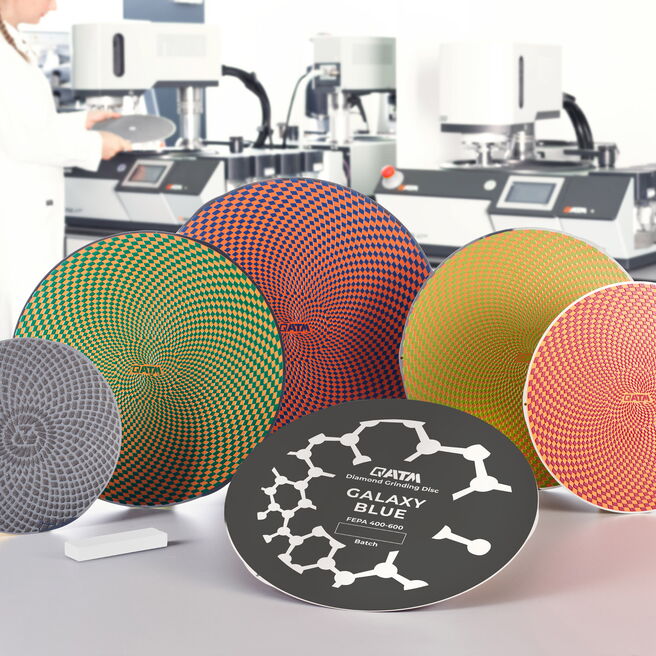
For mineralogical samples, diamond grinding wheels with resin or metal bonds are mainly used, because on hard, heterogeneous material they offer higher stock removal, better flatness and lower relief formation than abrasive papers.
| Consumable | Construction | Product advantages | Recommended applications |
|---|---|---|---|
| QPREP GALAXY diamond grinding disc | Specially arranged elements containing resin-bonded diamond grains on a stainless steel carrier; color-coded, FEPA grain sizes P80 to P1000 | High stock removal, short machining time, high planarity | Planar and fine grinding of medium-hard and hard materials; used particularly in fully automatic preparation systems |
| QPREP VEGA diamond grinding disc | Nickel-bonded diamonds on a zinc-plated metal carrier with a non-slip back print for secure adhesion to the magnetic foil | High stock removal, particularly high planarity, very long service life | Planar and pre-grinding of hard materials, rocks, ceramics and composites; grinding of unmounted samples; especially recommended for manual preparation |
| Silicon carbide abrasive papers | Bonded silicon carbide grains on a paper backing, available in several grain sizes | Fine control of removal on sensitive material | All minerals and ores; optimum results on soft and sensitive samples; grinding and, where required, polishing |
| QPREP diamond cup grinder | Diamond cup wheel used with the vacuum specimen holder in precision cutting machines | Plane-parallel sample preparation, stock removal with high accuracy, very high repeat accuracy | Thin section technology, petrographic examinations, target preparation, defect analysis |
The QPREP consumables program also covers aluminum oxide, silicon carbide and diamond grinding pads, polishing cloths, and diamond pastes, sprays and suspensions, so that the abrasive can be matched to the hardness, density and sensitivity of the sample. On QATM grinding and polishing machines, speed, pressure, time and direction of rotation are set and stored in the control system, which is what makes a method reproducible rather than operator-dependent.
How is a rock thin section prepared step by step?
A thin section is produced in six steps: cutting, mounting and impregnation, flat grinding, bonding to a glass slide, pre-thinning by cutting, and final grinding to approximately 20 to 30 µm.
- Cutting. A representative slice is separated from the starting material with a diamond precision cut-off wheel, with effective cooling and without thermal damage or fracture.
- Mounting and impregnation. Brittle, porous or fractured samples are impregnated with low-viscosity epoxy resin, under vacuum where fine pores and cracks are present.
- Flat grinding. The sample is ground flat. Depending on the material, an abrasive grain size of approximately 65 to 75 µm can be used. Grinding is carried out with low contact pressure, low speed and good cooling. The sample is checked under a stereomicroscope after each preparation step, and coarse scratches are avoided.
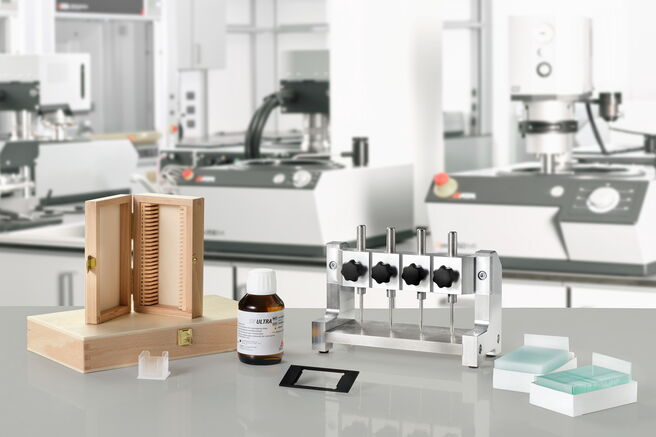
- Bonding to the glass slide. After the sample has dried, the ground side is bonded to a glass slide with Qpox 90, Qpox 92 or Qpox 94, or with the light-curing adhesives QPREP 50UV or 55UV. The sample is pressed on with the QATM thin section press to avoid detachment and bubble formation.
- Pre-thinning. Once the adhesive has cured, the glass slide is clamped in the vacuum clamping device available for the Qcut 150 A and Qcut 200 A, and the sample is pre-cut to a thickness of approximately 300 to 1000 µm while plane parallelism is maintained. The achievable thickness depends on the material, the mounting and the cutting machine.
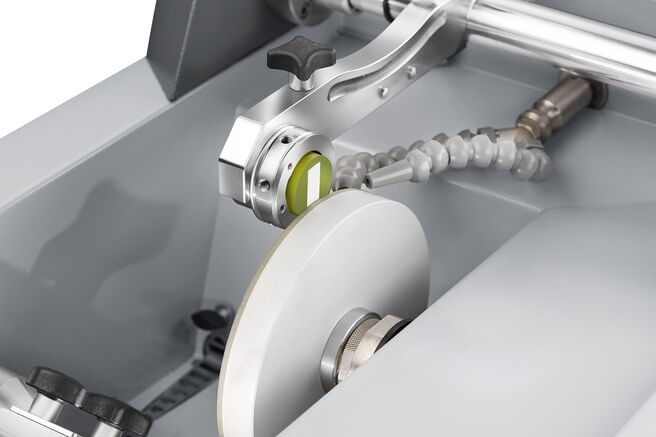
- Final grinding. The sample is ground to its final thickness with QPREP diamond cup wheels of various grit sizes, using the same vacuum clamping device. The grinding process can be completed with a grit size of approximately 22 to 18 µm.
Pores and cracks that were opened during pre-thinning must be closed again before final grinding. A suitable medium such as Qpox 94 is used for this purpose. If this step is skipped, the open cavities enlarge during grinding and fragments break out of the section.
What requirements must a glass slide for thin sections meet?
The glass slide must have a defined and known thickness, because the later analysis looks through both the sample and the slide. Where the thickness is not defined, the slide has to be pre-ground to a defined thickness before use.
One side of the slide should be roughened so that the adhesive bonds reliably. QATM glass slides meet both requirements. Their specification:
- low-stress glass, to prevent glass breakage
- glass thickness greater than 1.5 mm, also to prevent glass breakage
- uniform glass thickness with a tolerance of ±0.05 mm
- low removal during surface grinding, which saves time and cost
- ground edges at 90°, to prevent injuries and chipping
- defined refractive index
- optional matting by a selected sandblasting process, for adhesion and for labeling
How do you know when a thin section has reached the correct thickness?
In many mineralogical workflows the final thickness is approximately 20 to 30 µm. The exact value depends on the material and on the analytical task, and it is assessed optically rather than measured directly, because the sample is bonded to the glass slide.
The inherent color of a known mineral phase is used as the criterion. Quartz is the usual reference, because it occurs in most rocks: correctly thinned quartz appears white, and a yellowish tinge indicates that the sample is still too thick. For easier assessment, QATM specimen holders for single pressure have an opening in the middle, so that the colors can be judged without removing the samples from the holder.
Once the required thickness has been reached, the section is examined in transmitted and polarized light. Where the sample is to be examined in reflected light, an additional polishing step is required, as described in the next section. For many thin sections, polishing is not necessary.
Which machines are used for final thin section grinding?
Final grinding can be carried out either on a precision cutting machine with a vacuum clamping device and diamond cup wheels, or on a grinding and polishing machine with dedicated specimen holders.
| Route | Equipment | Characteristics |
|---|---|---|
| Precision cutting machine | Qcut 150 A or Qcut 200 A with vacuum clamping device and QPREP diamond cup wheels | Optimum reproducibility on the Qcut 200 A thanks to the high-precision automatic Z-axis; plane-parallel removal with high accuracy |
| Grinding and polishing machine | Qpol GO 1 / GO 2 with specimen holders for single or central pressure | Single contact pressure is particularly flexible; two pressure stamps press the specimens down evenly; silicon carbide abrasive papers in several grain sizes for grinding and, where required, polishing |
The QPREP diamond cup grinder is recommended when a specimen with parallel faces is required after precision cutting. Used in the Qcut 150 M, Qcut 150 A and Qcut 200 A with a vacuum specimen holder, it provides plane parallelism, high surface quality and high repeat accuracy.
鉱物学的試料調製 最終準備、消耗品、および方法の選択
最終的な調製結果は、材料、分析方法、および要求される表面または薄切片の品質に対して、適切な機器、消耗品、調製パラメータを選択することに依存します。
When does a thin section need polishing, and which polishing cloth should be used?
Polishing is required when the prepared section is to be examined in reflected light. For examination in transmitted light only, polishing of the thin section is usually not necessary.
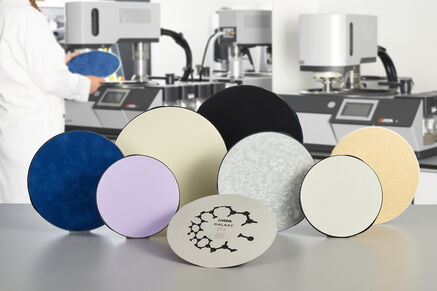
The polishing cloth is selected according to the grain size, the abrasive and the polishing objective:
| Polishing cloth | Suggested grain size | Abrasive | Properties | Application |
|---|---|---|---|---|
| GALAXY PHI | 9 – 1 µm | Diamond | Medium-hard chemical fiber cloth | Pre-, intermediate and final polishing |
| GALAXY ALPHA | 15 – 3 µm | Diamond | Very hard, perforated chemical fiber cloth | Pre-polishing |
| GALAXY DELTA | 9 – 3 µm | Diamond | Medium-hard silk cloth | Pre- and intermediate polishing |
| GALAXY IOTA | 3 – 0.005 µm | Diamond, oxide suspension | Long-flocked, soft synthetic cloth | Final polishing, and fine polishing with fine polishing suspension |
Which consumables should be selected for which mineral sample?
Consumable selection follows the hardness, structure, porosity and sensitivity of the sample.
| Sample condition or preparation task | Recommended consumable |
|---|---|
| Hard and brittle rocks, ores and minerals | QPREP diamond precision cut-off wheels |
| Porous, cracked or fractured specimens | Low-viscosity epoxy resins, applied with vacuum impregnation |
| Powders, drill cuttings and soft rocks | Low-viscosity epoxy resin for full enclosure, or hot mounting at Ø 25 to 30 mm |
| Soft and sensitive minerals and ores | Silicon carbide abrasive papers |
| Planar and fine grinding of medium-hard and hard materials | QPREP GALAXY diamond grinding discs (FEPA P80 to P1000) |
| Hard materials, rocks and unmounted samples | QPREP VEGA diamond grinding discs |
| Plane-parallel thin section technology and petrographic examinations | QPREP diamond cup grinders with vacuum specimen holder |
| Bonding the sample to the glass slide | Qpox 90, Qpox 92, Qpox 94, or QPREP 50UV / 55UV light-curing adhesives |
| Pores and cracks reopened after pre-thinning | Qpox 94 or a comparable filling medium |
| Reflected light examination of a polished thin section | GALAXY PHI, ALPHA, DELTA or IOTA polishing cloths |
Which standards and method references apply to petrographic sample preparation?
Depending on the sample type and the application, laboratories refer to internationally recognized method standards for petrographic examination and for specimen preparation.
| Reference | Scope |
|---|---|
| ASTM C295/C295M | Petrographic examination of aggregates for concrete |
| ASTM C856/C856M | Petrographic examination of hardened concrete |
| ASTM E3 | Preparation of metallographic specimens; the general principles also apply to polished mineral sections |
| ISO 14689 | Identification, description and classification of rock material and rock mass |
Always verify the latest applicable version and the exact scope of a standard before using it in a regulated or accredited laboratory workflow. QATM equipment and consumables support preparation to these methods; the method itself is defined by the laboratory.
Who is this preparation workflow for, and who is it not for?
This workflow fits laboratories that need flat, plane-parallel, structure-preserving surfaces and thin sections from solid or consolidated mineral material.
It is a good fit for:
- geology, mining, petrography and ore analysis laboratories preparing rocks, ores, minerals, powders and fossils
- laboratories that need thin sections at approximately 20 to 30 µm for transmitted and polarized light microscopy
- laboratories that need polished sections for reflected light microscopy, scanning electron microscopy or electron microprobe analysis
- quality control laboratories for aggregates, hardened concrete and other mineral building materials
- university and research laboratories with mixed, low-volume sample types, and production laboratories with high, repeatable sample volumes
It is not the right solution for:
- bulk sample comminution, division and sieving before chemical analysis — for milling and sieving, see Retsch, also part of Verder Scientific
- preparation of fused beads or pressed pellets for X-ray fluorescence analysis
- histological or biological sectioning with a microtome, which uses a different technique from mineralogical thin sectioning
- unconsolidated wet sediments, soils or slurries that have not first been dried and stabilized by impregnation
- determination of the elemental or mineralogical composition itself — the preparation described here produces the specimen; the analysis is performed on a microscope, spectrometer or diffractometer
QATM equipment and consumables for mineralogy and thin section preparation
QATM covers the full preparation chain for geology, mining and mineralogy, from the first cut to the finished thin section.
| Preparation step | QATM solution |
|---|---|
| Cutting | Manual, semi-automatic and fully automatic cut-off machines; Qcut 250 M, Qcut 150 A and Qcut 200 A precision cut-off machines with vacuum clamping device |
| Cutting consumables | QPREP diamond precision cut-off wheels, plus CBN, corundum and silicon carbide wheels |
| Mounting | Hot mounting presses, cold mounting systems and UV mounting devices |
| Mounting consumables | QPREP hot, cold and UV mounting materials, including low-viscosity epoxy resins with a refractive index close to glass |
| Impregnation | QATM vacuum impregnation device for filling pores and cracks |
| Grinding and polishing | Qpol manual and semi-automatic machines; Qpol 250 BOT and Qpol 300 BOT fully automatic systems with central pressure |
| Grinding and polishing consumables | QPREP GALAXY and VEGA diamond grinding discs, silicon carbide abrasive papers, GALAXY polishing cloths, diamond pastes, sprays and suspensions |
| Thin sectioning | QATM thin section press, QATM glass slides, Qpox 90/92/94 and QPREP 50UV/55UV adhesives, QPREP diamond cup grinders, vacuum clamping devices |
| Method development and documentation | QATM application laboratory, preparation methods database and QPREP solution boxes |
QPREP mounting materials are available for all three methods. For thin sections, including thin sections of powdered samples, low-viscosity epoxy resins are used, because they fill pores and cracks well and, in the case of powders, enclose the particles reliably.
FAQ - Thin sectioning and mineralogy
What thickness does a mineralogical thin section need?
In many mineralogical workflows the final thickness is approximately 20 to 30 µm. The exact value depends on the material and on the analytical task. Because the sample is bonded to a glass slide, the thickness is assessed optically: correctly thinned quartz appears white, and a yellowish tinge indicates that the sample is still too thick.
Why is sample preparation important in geology and mining?
In geology and mining, sample preparation determines whether the mineral structure is preserved or damaged. Incorrect cutting, mounting or grinding creates cracks, pull-outs, deformation and relief formation, and the analysis then describes preparation artifacts instead of the material.
Which mounting method is suitable for mineralogy and thin sections?
Cold mounting with low-viscosity epoxy resin is the most common method for mineralogical samples and thin sections, because the resin penetrates pores and cracks and because grades with a refractive index close to glass are available. Hot mounting and UV mounting are also suitable, depending on the sample and the preparation goal; UV mounting is the fastest but does not usually achieve complete impregnation of fine pores and cracks.
Why is vacuum needed when impregnating rock samples?
Without vacuum, the air trapped in pores and cracks prevents the mounting material from entering. Evacuating the vacuum container empties the cavities of air, so the low-viscosity mounting material can penetrate them. Filled pores and cracks do not enlarge or break out during grinding and polishing.
How long does epoxy resin need to cure for mineralogical samples?
The curing time of the epoxy resins used for mineralogical samples and thin sections is approximately 3 to 24 hours, depending on the selected material. To reduce bubble formation, samples can be stored for approximately 2 hours at 2 bar overpressure after the mounting mold has been filled.
What is the difference between a thin section and a polished section?
A thin section is thinned to approximately 20 to 30 µm, bonded to a glass slide and examined in transmitted and polarized light. A polished section, also called a bulk sample, keeps its full thickness and is examined in reflected light or in the scanning electron microscope, so only the surface has to be flat and free of relief.
To what thickness is a thin section pre-thinned before final grinding?
After the adhesive has cured, the sample is pre-cut to approximately 300 to 1000 µm while plane parallelism is maintained, using a vacuum clamping device on the Qcut 150 A or Qcut 200 A. The achievable value depends on the material, the mounting and the cutting machine. Final grinding then brings the sample to approximately 20 to 30 µm.
Do thin sections have to be polished?
For many thin sections, polishing is not necessary. Polishing is required when the sample will be examined in reflected light. In that case, GALAXY polishing cloths are selected according to grain size, abrasive and polishing objective.
QATM機器で調製できる鉱物サンプルはどれですか?
QATM equipment is used for rocks, ores, minerals, powders and fossils, including granite, basalt, sandstone, limestone, marble, slate, quartzite, gneiss, iron ore, copper ore, zinc ore, gold-, silver- and platinum-bearing materials, quartz, feldspar, calcite, pyrite, tourmaline, beryl, topaz and fossil material.
Which QATM products are used for thin section preparation?
Qcut precision cut-off machines, QPREP diamond precision cut-off wheels, QATM glass slides, Qpox 90/92/94 adhesives, QPREP 50UV and 55UV light-curing adhesives, the QATM thin section press, vacuum clamping devices, QPREP diamond cup grinders and Qpol grinding and polishing machines.
Can powdered and loose mineral samples be prepared as thin sections?
Yes. Powders and soft rocks must be sufficiently deagglomerated and then fully enclosed by the mounting material, so that particles do not break out later. Low-viscosity epoxy resin is used for thin sections of powdered samples; alternatively, powders can be mounted in a hot mounting press at typical diameters of Ø 25 to 30 mm.
Need reliable mineralogy and thin section preparation for your laboratory?
Contact QATM to define the cutting, mounting, impregnation, grinding, polishing and thin sectioning route for your mineral samples. Samples can also be prepared and documented in the QATM application laboratory before a purchase decision.
お問い合わせ
地質学や鉱物学のためのマテリアログラフィー試料作製について詳しくお知りになりたい方、または弊社製品にご興味をお持ちの方は、お気軽にお問い合わせください。お客様のニーズとご予算に合った製品をご提案させていただきます。お電話、Eメール、またはウェブサイトからお問い合わせください。お問い合わせお待ちしております。