





In metallography, mounting is typically the second process step after sectioning. Mounting encapsulates the sampled material with a plastic shell and prepares the sample for the following metallographic grinding and polishing step. In many cases it leads to a simplified sample preparation and thus to better results.
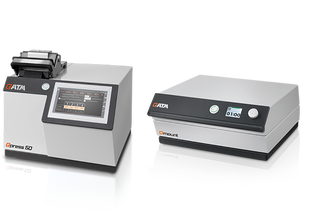
QATM is a leading manufacturer and supplier of high-quality consumables as well as a range of innovative machines, from hot mounting presses to UV mounting devices. The QATM application experts combine decades of experience with thousands of processed materialographic samples and will be happy to assist with your application.
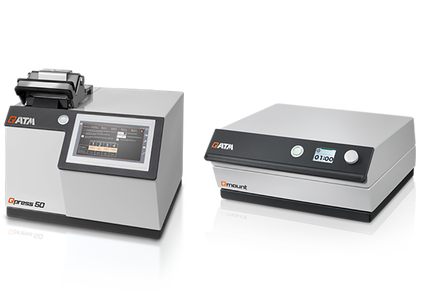
QATM offers metallographic cut-off machines for any requirement
Advantages of metallographic mounting
- Unwieldy samples with small or complicated dimensions are fixed in cylindrical solids that can be easily handled. Often mandatory for semi-automatic metallographic grinding and polishing with standardized sample holders
- Sensitive samples, e. g. soft, brittle, fragile, porous solids, are protected during the metallographic grinding process. Better edge retention protects coatings and marginalized layers as well
- Several samples can be combined in one solid
- Preservation of marginalized layers and coatings, as in the case of nitrided steels, plasma-sprayed coatings, or paint layers.
- Improves further processing with semi or fully automatic metallographic grinding and polishing devices, guidance in sample holders, consistent size, i. e. the sample diameter is adjusted.
The difference between cold and hot mounting in metallography
In metallography, a distinction is made between hot and cold mounting, depending on whether heat is required for the polymerization process. It must be noted that during cold mounting polymerization temperatures of up to 130 °C may arise when using, e. g., methyl acrylates.
Today, the term cold mounting is generally used for all methods where no or small pressures (<5 bar) are applied.
When it comes to the selection of metallographic mounting methods, arguments for or against a certain method can be found. The below overview presents the process differences between metallographic hot and cold mounting.
| Feature | Metallographic Hot Mounting | Metallographic Cold Mounting |
|---|---|---|
| Devices | Mounting press | Take-off the pressure device if necessary, infiltration set |
| Plastic types | Phenolic resin, Acrylic resin, Epoxy resin | Methyl methacrylate, Polyester resin, Epoxy resin |
| Time expenditure per process | 10 - 15 min | 5 minutes – 12 h (depending on the plastic types) |
| Handling | Simple, granulate/powder is filled in the mold assembly | Observe dosage (volume or weight %), mixing of 2-3 components |
| Flexibility in terms of shape selection | Limited, significant additional costs | Large, with low cost |
| Result | Plane-parallel specimens, depending on the type of granules, hardness, low gap and transparency can be achieved | No plane-parallel specimens, depending on the plastic selection, hardness, low gap and transparency can be achieved |
| Cost expenditure for plastic/granulate | Costs are considerably lower | Costs are considerably higher |
| Occupational safety | Observe safety data sheets. Use extraction unit | Observe safety data sheets. Use take-off unit |
Requirements for metallographic mounting compounds
Metallografische hete en koude Inbedden staan niet in directe concurrentie, maar er is wel een zekere overlap in toepassingsgebieden. De belangrijkste criteria voor verbindingen zijn hardheid, slijtvastheid, krimp en chemische bestendigheid>.
Lage krimp tijdens de stolling en goede hechting aan het monster zijn belangrijk. Zonder dit zal er een spleet ontstaan tussen het monster en het Inbedden. Dit veroorzaakt randafgeronding, ophoping en overdracht van Slijpen en Polijsten of het breken van oppervlaktecoatings.
The following points need to be observed as well:
- Bubble-free condition – ground air bubbles act as pores and promote the carryover of grinding and polishing media
- Correct viscosity during casting. All irregularities in the sample such as cracks, shrink holes or pores must be filled.
- Identical metallographic grinding or polishing behaviour as the mounted material. Soft materials should be mounted in soft and hard materials in hard mounting media
- Inert behaviour of the material during metallographic sample preparation and analysis
- No reaction with the sample
- The material must not be changed by high temperatures or pressure during the process; undesirable deformations and transformations could be the result
- If necessary, good electrical conductivity for further processingi n metallographic electropolishing or electron microscopic applications
| Metallographic hot mounting compounds | Metallographic cold mounting compounds |
|---|---|
| Powder, granules or preforms are compacted under pressure and heat in a press | Liquid and/or powder is mixed with hardener and poured into mounting moulds |
Raw material can be stored for as long as required |
Raw material must be stored in a cool place and has a limited shelf life |
Processing time for one sample is 10 to 18 minutes, a maximum of two samples per cylinder is possible |
Curing time for one sample is approx. 15 minutes to 12 hours. Several samples can be mounted simultaneously |
Duroplast: Phenolic resin (bakelit), epoxy resin |
Duroplast: Epoxy resin, polyester resin |
Polymerised to a mass that cannot be softened further |
Polymerised to a mass that cannot be softened further |
Heating up to approximately 150-200 °C under pressure (200 bar) |
Pay attention to temperature of polymerization during polymerization. This depends on the mixing ratio, the external temperatures, the quantity of components used and the heat dissipation of the mounting moulds |
| Thermoplastics: Acrylates | Thermoplastics: Acrylates |
| Can be softened again, heating without pressure, cooling under pressure | Can be softened again, temperature increase 50-120 °C, short hardening time |
Metallographic Hot Mounting
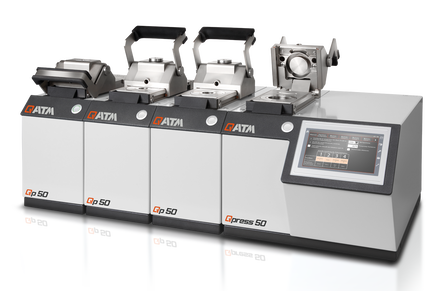
Hot mounting could also be called hot biaxial pressing. It is a process in which a granulated polymeric material is softened, compressed, and cooled down sequentially. The process is carried out in a metallographic hot mounting press, designed for this application.
Of course, this method may only be applied on sufficiently pressure- and temperature-resistant samples with simple geometries. The process is carried out at temperatures of 150 to 200°C, while the pressure depends on the mould diameter and ranges from 100 to 300 bar. After placing the sample on the lower ram, the mounting material is added and the process started.
Two types of materials are used:
- Thermosets, e.g. phenolic resins with differing fillers, melamine and epoxy resins with mineral fillers, or thermoplastics. Thermosets cross-link at high temperatures and can not be molten afterwards.
- thermoplastics, e.g. PMMA powders, which form transparent solids after curing. They melt at high temperatures and only start to gain hardness during the cooling process.
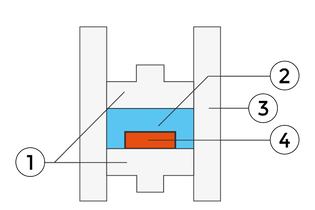
- pressing die
- hot mounting mass
- press cylinder
- sample
Metallographic hot mounting materials and their properties
| Property | Duroplast | Duroplast | Duroplast | Thermoplastic |
|---|---|---|---|---|
| Phenolic resin | Epoxy resin | |||
| Filling material | Medium | Copper, graphite | Glass, mineral material | None |
| Hardness | Medium | Medium | Very high | Low |
| Gap formation | Existent | Existent | Very low in gaps | Existent |
| Grindability | Good | Good | Very good (not for grinding stones) | Satisfactory |
| Chemical resistance | Good | Good | Good | Satisfactory |
| Electrical conductivity | None | Good to very good | None | None |
| Product | Bakelit black, red, green | Duroplast black | EPO black, EPO max | Thermoplastic |
Thermosets are usually cured between 150°C and 180°C, while the processing window of thermoplastics is slightly bigger. Because they are hardened during the cooling process, their cooling times, depending on the mould diameter, are longer than those of thermosets. In this case, the cooling rate, which is usually lower, must be considered.
Therefore, metallographic hot mounting presses have pulsed cooling modes, which contribute to the release of the plastics’ internal stresses during curing. This prevents crack formation and guarantees a clear sample.
| Parameters | Duroplast | Thermoplastic |
|---|---|---|
| Polymerization range | 150-190°C | 130-195°C |
| Holding time | 5-8 min* | 5-8 min* |
| Cooling time | 3-6 min* | 7-10 min* |
| Pressure | 150-180 bar* | 160-190 bar* |
* Depending on the diameter of the mould assembly; the greater the mold diameter, the more pressure and time is needed.
Due to the required process parameters, hot mounting of metallographic samples is a limited application. These limitations apply to electronic assemblies (solders/composites) or pressure-sensitive materials, such as wires or sheets with small cross-sections. In modern presses, this fact is taken into account by shifting the pressure onset to the point where the target temperature is reached. This extends the application range of the process, but complex network structures or porous rock cannot be hot mounted.
The plane-parallelism of the samples and the easy handling of the process are of advantage, especially in hardness testing.
It is possible to use several compounds in layers. This allows the specimen to be mounted in hard a medium. Afterwards, a cheaper filling material is used, which is covered by a transparent material to enclose a sample identification.
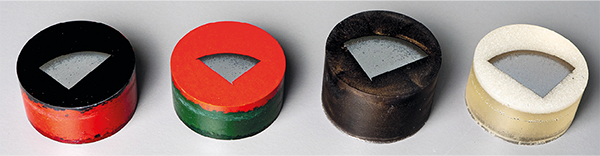
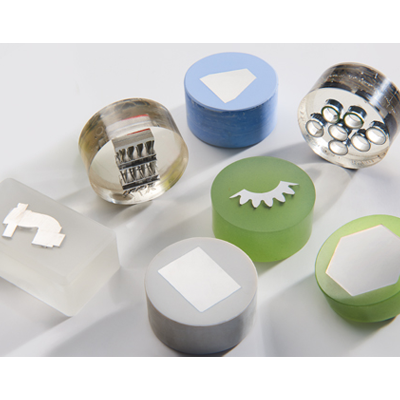
Four samples mounted using different compounds
Metallographic Cold Mounting
The technical requirements of cold mounting are minimal compared to the metallographic hot mounting process. Only a mold and the cold material compound are required. In addition to hardness and abrasion resistance, shrinkage, curing (pot life), and exothermic heat development are the main selection criteria. The process is carried out as follows:
The sample is placed in a mould and the exact weight or volume proportions of the mounting components are carefully measured. These are then thoroughly mixed (left image) and poured into the mould (right image). Small samples should be fixed in place before the casting process.
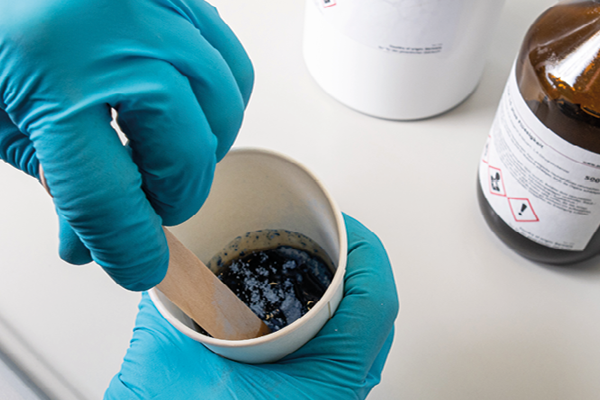
Mixing of the compounds
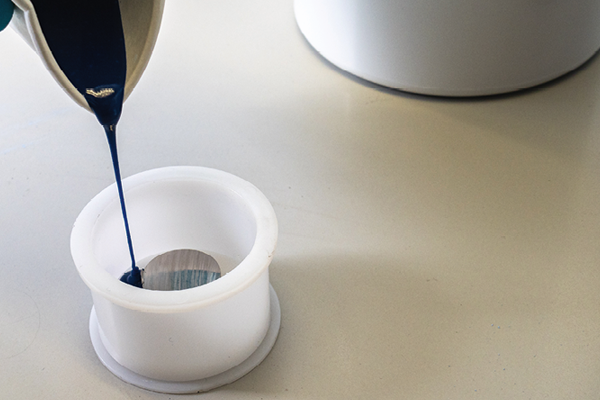
Pouring of the compounds
Four classes of materials are available:
- Acrylic resin
- Polyester resin
- Epoxy resin
- Light curing materials
Selection of the appropriate mould
The moulds used for metallographic cold mounting are reusable. Here only the most commonly used moulds are described. Various constructions, for example based on polymer-coated metal parts or different plastics, may be observed in laboratory practice.
- Polyolefin based moulds (PE and PP)
In case of older moulds, the removable base is often no longer flat. If several small parts are mounted in one sample, different grinding planes can be created depending on the position of the individual sample. - Teflon (PTFE) based moulds
Due to their high dimensional accuracy, ideally suited for automatic grinding and polishing, expensive. - Silicone rubber-based moulds
After repeated use, silicone moulds lose their roundness, which can be a disadvantage for automatic preparation in single pressure. When polyester resins are used, sticky spots may arise as a reaction between the mounting compound and the silicone mold. These moulds are also suitable for the hardening of UV-initiated compounds.
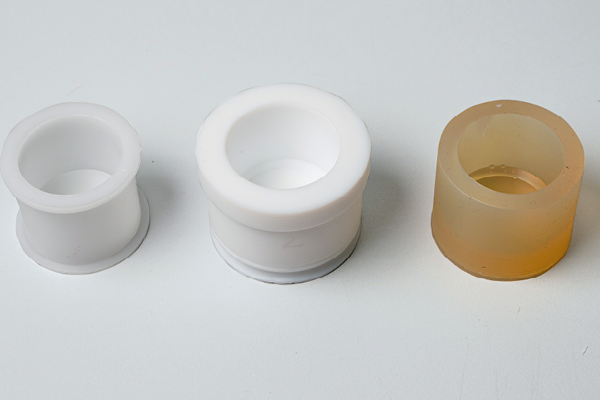
Different moulds used in metallography
Special Methods of Metallographic Cold Mounting
Vacuüm impregneren
Poreuze materialen zoals keramiek, gesinterde materialen of spuitcoatings moeten onder vacuüm worden gemonteerd. Dan kun alle open poriën die verbonden zijn met het oppervlak worden gevuld met het inbedden. Dit is mogelijk met epoxyharsen omdat de dampdruk en viscositeit voldoende laag zijn. Toch moet het vacuüm beperkt blijven tot een druk onder 0,8 bar, anders zullen de componenten met een lage kooktemperatuur van het epoxy-systeem gas afgeven of beginnen te koken. Dit proces kan worden gebruikt om gevoelige materialen te versterken en te beschermen. Ongewenste voorbereidingseffecten zoals barsten, scheuren en overmatige porositeit worden tot een minimum beperkt. Dit geldt echter alleen voor voornamelijk open-poreuze materialen; andere, zoals vrij dicht gesinterde keramiek, kunnen niet goed worden geïnfiltreerd. Schade door reactiewarmte of druk worden niet verwacht - nog een andere reden waarom er geen alternatief is voor deze procedure voor poreuze materialen.
Vacuum impregnation is used for infiltration of porous samples and for optimum metallographic mounting of samples with thin holes, fine pores or micro cracks.
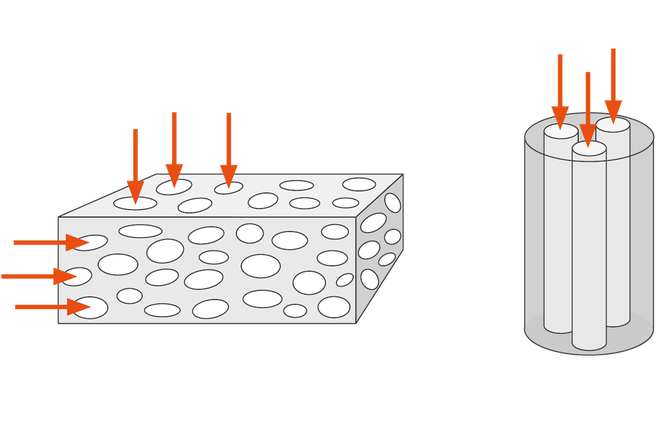
Infiltration of porous material or thin holes
Application of overpressure
Metallographic cold mounting under pressure only makes sense when using acrylates. A simple pressure device is required (compressed air connection 5-6 bar). Better transparency is achieved with unfilled methacrylates. The applied overpressure of 2 to 2.5 bar increases the boiling point of the compound and suppresses the formation of gas bubbles during polymerization. This enables crystal-clear mounted samples. Pressure cannot replace vacuum as the gas volume cannot completely escape from the pore volume. Therefore, open pores remain partially unfilled and cause the formation of preparation artefacts.
How to avoid marginal gaps
Even when high-quality products are used, the formation of marginal gaps cannot always be avoided and occurs especially during cold mounting. This is often due to inadequate preparation of the sample or its geometry. To avoid the formation of marginal gaps, attention should be given to the following:
- Sample geometry
Simple rectangular cross-sections are unproblematic. Dovetail connections or drill holes place high demands on the metallographic mounting compound.Especially with inner radii, a non-existent and/or negative shrinkage wouldbe required to mount with minimal gaps.

simple
difficult
- Arrangement of samples in the mould
Very little distance between individual samples or to the edge of the mould can cause gaps to form and promote crack formation (approximately 2-3 mm distance should be maintained). Breakouts can occur especially at the edge of the specimen which complicates the preparation and may lead to artefacts.

incorrect
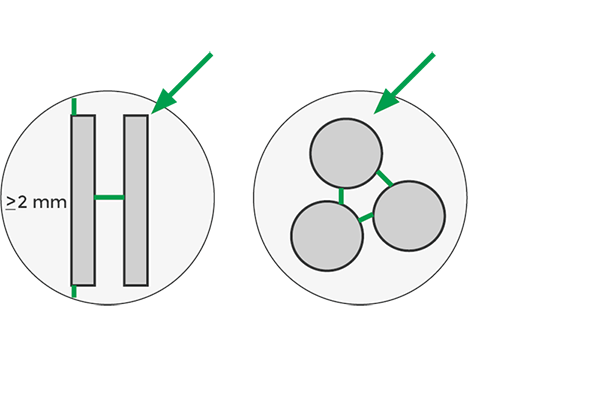
optimum
- Thermal conductivity
The risk of gap formation increases the faster the mounting material is cooled down (special caution with methacrylates!).
For a sharp-edged preparation and protected boundary areas, it is crucial to observe the correct hardness of the metallographic mounting material. In general, a mounting material should be as hard and impact-resistant as possible to achieve a metal-like removal behavior. For this reason, high-filled systems are always used when transparency is not required. This reduces the shrinkage of the material.
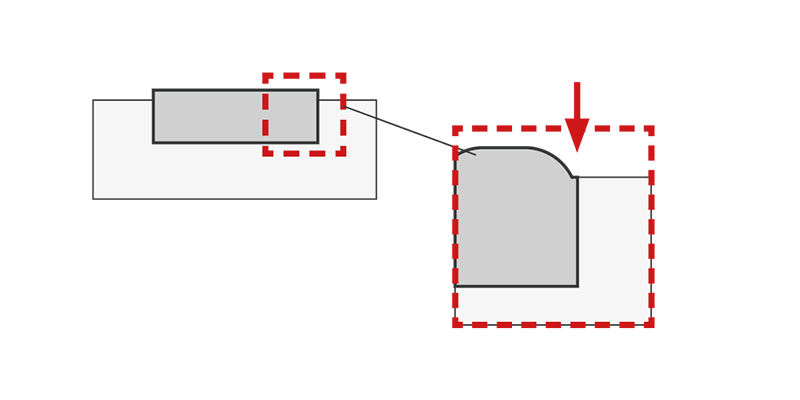
Different hardness for sample and mounting material.
Poor transition of mounting material to sample
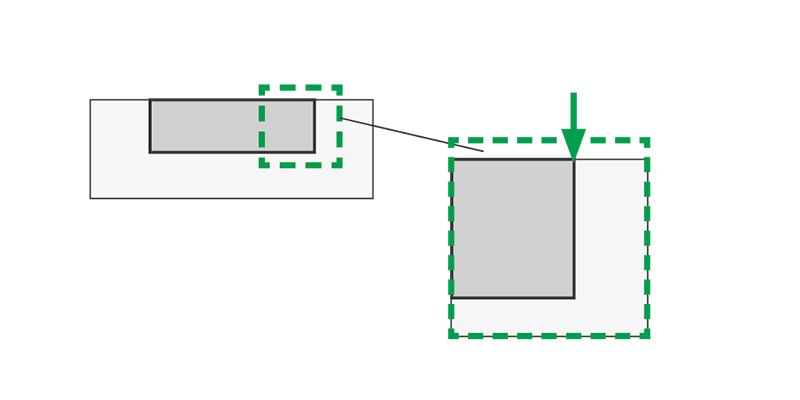
Identical hardness of sample and mounting material.
Ideal transition of mounting material to sample
The gaps between sample and metallographic mounting material should be as small as possible. Marginal gaps and edge rounding bear the risk of carrying over dirt and grinding or polishing particles. This leads to a deterioration of the metallographic preparation result. Leaking etchant or cleaning alcohol can then falsify the micrographs due to after-etching or discoloration in areas close to the gaps.

Shrinkage gap - poor transition of mounting material to sample
Contact us today
QATM offers a wide range of innovative machines for metallographic mounting, from robust hot mounting presses to devices for cold mounting under UV irradiation. Accompanying QATM mounting consumables are thoroughly tested and selected for perfect interaction with our machines. Contact us for a consultation, quote or to talk to one of our dedicated application specialists!